
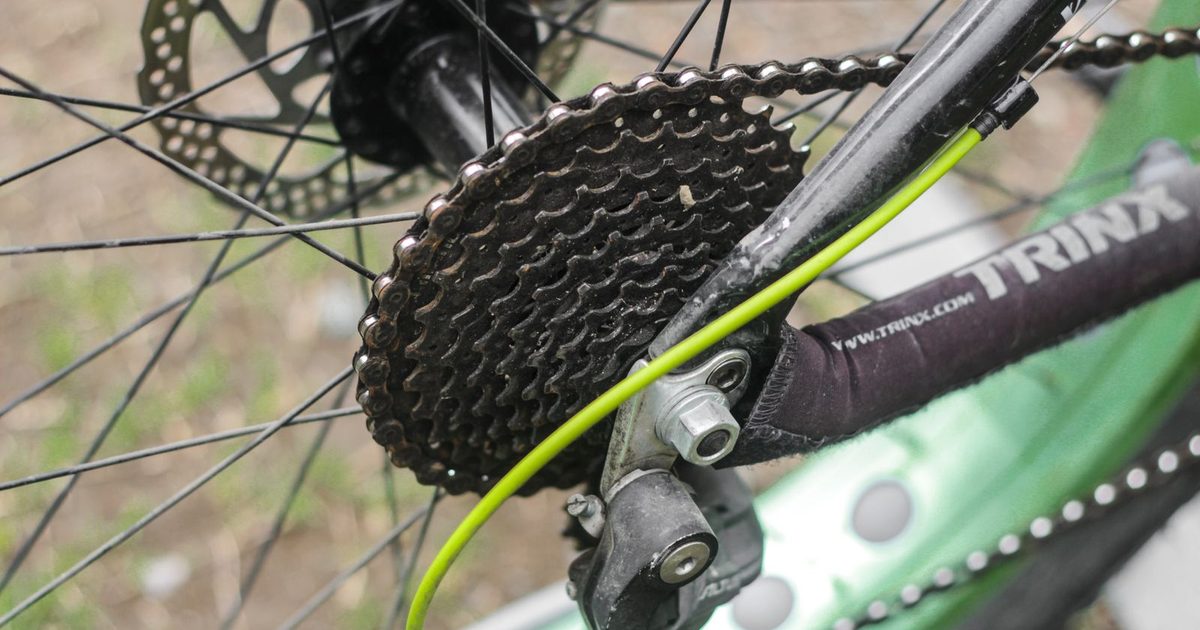
A bicycle in the Gulf does not wear out the way the manuals assume. Most maintenance advice is written for temperate, wet climates, where the enemy is rain and road salt. Here the enemy is fine sand, sustained heat and coastal humidity, and they attack different parts in a different order.
Sand does not wear your chain. It turns your lubricant into a grinding paste.
This is the single most expensive misunderstanding in Gulf cycling. Riders lubricate a dusty chain, which feels like maintenance and is closer to the opposite. Wet lubricant is sticky by design — that is how it stays on. Fine desert sand bonds to it and you have made a lapping compound, held exactly where the chain, cassette and chainrings press against one another.
The order matters more than the product. Clean first, dry completely, then lubricate, then wipe the excess off the outside of the chain. Lubricant belongs between the rollers and the pins. Anything left standing on the outer plates is mostly there to collect sand — wipe it back to a film, not to bare metal.
A dry or wax-based lubricant collects far less than a wet one in these conditions. It needs reapplying more often. That is the correct trade here, and it is the opposite of the advice most riders arrive with.
Heat thins everything you rely on
Lubricant viscosity falls as temperature rises. A wet oil that stays put in a European summer runs thinner at UAE midday and flings off the chain sooner, which is why the interval that worked there does not transfer here. A bike ridden at 45°C is losing lubricant faster than the same bike at 20°C, on the same ride.
Tubeless sealant behaves the same way. It relies on a liquid carrier that evaporates, and evaporation is a temperature problem. A sealant that would last a season elsewhere can dry to a skin inside the tyre far sooner here — and a dried tyre gives no warning while you ride — you find out at the puncture it was supposed to seal. Check it: pull the valve core and dip a cable tie in. Less than a centimetre of wet sealant on the tie means top it up.
Tyres and anything rubber or textile take a second hit from UV. Sidewalls, bar tape and saddle covers age from sunlight as well as from mileage. A bike stored on a balcony ages even when it is not ridden.
The coast corrodes what the desert does not
Riding the Corniche or Hudayriyat means salt-laden humid air, which is a corrosion environment, not an abrasion one. It goes after different things: cable inners inside their housing, chain pins and side plates, bolt heads, and the small steel hardware in derailleurs and brake calipers.
Corrosion in a cable is invisible from outside. It presents as shifting that has become stiff or vague, which most riders read as a derailleur that needs adjusting. Adjusting it does not fix a corroded inner, and the symptom comes back. The test takes a minute: slacken the cable, pull the housing off its stops and slide the inner by hand. If it drags, no barrel adjuster will save it.
Sealed bearings hold out grit better than they hold out pressure
Cartridge bearings in hubs, bottom brackets and headsets run contact lip seals. Coarse sand does not get past them. Airborne dust — the suspended fraction, a fraction of the width of a grain of sand — is small enough to work past the lip over time, and pressurised water carries it there faster than wind does.
Once it is inside it does not work its way out on its own. It grinds until someone opens the bearing, cleans it and repacks it. Left long enough the races pit, and then the bearing has to be replaced instead.
This is why bearing services start at a General Service rather than sitting on the rate card as an optional extra — and why a Full Overhaul opens every one of them. In a temperate climate the manufacturers say once a year and most riders stretch it. Here, deferring is how a hub service from AED 80 becomes a new hub, and on a wheel with a proprietary hub, a new wheel.
Pressure washing is the fastest way to ruin a bearing
A dusty bike invites a hose, and the more dust the higher the pressure people reach for. A pressure washer aimed at a hub, bottom bracket or headset drives water and grit straight past the seal it is supposed to bounce off. The bike looks immaculate and the bearings have been given exactly what they cannot expel.
Low pressure, a brush and a bucket. It is slower and it is the reason a drivetrain lasts.
What 207 service bookings actually say
Every GOCYC booking asks you to describe what is wrong before a technician sets off. Across 207 of those descriptions from Abu Dhabi and Dubai, this is what riders said:
| What the rider mentioned | Bookings |
|---|---|
| Tyres, tubes, punctures | 29 (14.0%) |
| Chain or drivetrain | 18 (8.7%) |
| Brakes | 15 (7.2%) |
| Gears and shifting | 13 (6.3%) |
| Wheels or spokes | 8 (3.9%) |
| Bearings, hubs, bottom brackets | 1 (0.5%) |
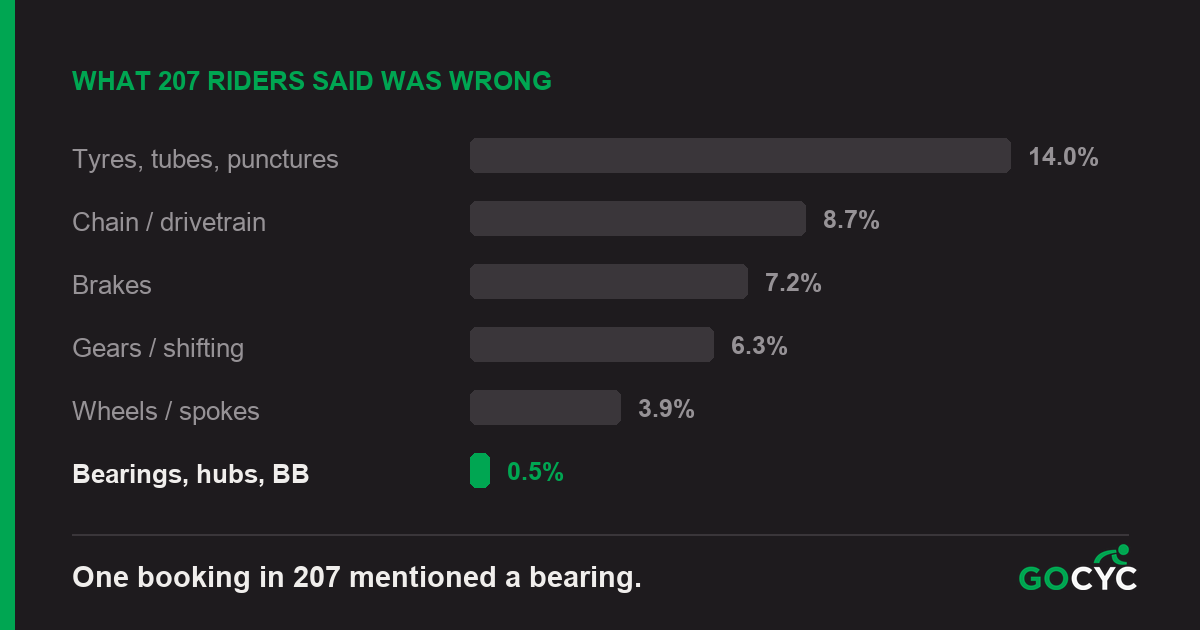
One booking in 207 mentioned a bearing.
That is not because bearings are fine here. It is because a worn bearing does not announce itself. A puncture stops the ride. A chain skips under load. Brakes squeal. A bottom bracket that has been quietly grinding through dust for a season does none of those things — it just gets slower, and you adjust to it without noticing.
The second number says the same thing from the other side: the most-booked package by a distance is the cheapest one, Wash & Lube, at around 42% of all bookings. Riders here book cleaning far more often than they book mechanical work. In a climate whose defining feature is fine dust getting into things, that is exactly backwards.
Two caveats, because they matter. These are what riders report at booking, not what the technician finds when the bike is opened — the gap between those two is the whole point. And 207 is a real sample but a small one, from one platform in two emirates.
What this means for a service interval
The interval that matters here is not distance, it is exposure. Two riders with the same odometer reading — one on Al Wathba in July, one indoors — are not on the same maintenance schedule, and treating them the same is how a drivetrain quietly wears out early.
If you ride in summer, on sand-blown routes, or near the water, assume you are on the shorter end of every published interval — particularly for chain wear, sealant and bearings.
A Basic Service at AED 199 covers tuning, torque and a safety check. Where dust has already reached the bearings, a General Service at AED 329 opens the bottom bracket and hubs. The honest answer for most Gulf riders is that the bearings need attention sooner than they expect and the chain needs measuring more often than it needs oiling.
Book in the app
The app is the better way to book. Your service history stays in one place, so the next technician can see what was done last time, and you are not waiting on an email thread to agree a time.
It is also not only for servicing. Bike rentals, event and group-ride registration, cycling gear from the shops we work with, and route maps for the tracks around Abu Dhabi and Dubai all sit behind the same login — one account rather than a different arrangement with a different shop for each one. Booking on the website works, but it is the only channel that cannot show you the rest.